


Because heritage lives only when it is lived,
because wooden boats have a soul,
because sailing connects generations,
because the gajeta Marija is not just a boat – she is a classroom, a stage, and a memory.
Learn more about the programme, sailing trips and experiences aboard the gajeta Marija:
https://www.mbdb.hr/en/sail-in-a-gajeta/

Meet the Gajeta Marija
According to oral accounts, the gajeta Marija was built in 1922 in the shipyard of the Filipi Tošulov family in Betina. Marija was first restored in 1934 in Sukošan, again by the Filipi family, who had moved there from Betina a few years earlier and established a shipyard. It was also registered at that time. Today’s registration papers list 1934 as the year of construction, as the earlier documents were lost.
Marija is 6.90 m long, 2.70 m wide, 0.88 m high, and has a carrying capacity of 2.2 tonnes.
Her first owner came from the village of Luka on Dugi Otok. As the family had fields outside the village, they used the gajeta to reach them. With her robust form — wide and deep — she was able to carry large amounts of cargo.
In 1954, the Stagličić family from Pašman bought the gajeta and named her Marija. At that time she was equipped only with a lateen sail and oars. An engine was installed in 1959 or 1960. Over the years she had four different engines, from Aran to Perkins.
The Stagličić family had fields on the opposite side of the island of Pašman, in the bay of St. Ante. From there they transported olives, grain, wheat and corn. They also had fields between Turanj and Sveti Filip i Jakov, where they grew wheat, grain and corn as well.
Marija carried oxen and horses used for ploughing the fields. When animals were replaced by machines, even a Tomo Vinković tractor was transported on the bow.
During the summer months they used the gajeta to sell vegetables, melons, watermelons and tomatoes. Their trading trips would take them to Tisno, Prvić Luka and Šepurine, and further to Šolta and Bol on the island of Brač. On the return journey they would buy cement in Split. They would make several such tours each summer.


During the 1970s the boat was used for extracting sand around Pašman. Each day they would collect one to two gajeta loads of sand, about 5–6 cubic metres in volume. Everything was done by hand with shovels.
The boat was also regularly used for fishing, most often using the traditional ludar fishing technique.
Over the years the bottom of the boat was replaced two or three times, the deck twice, and the keelson once, while the hull planking was never replaced.
In 2012 Marija was transported from Pašman to Betina, to Ćiro’s shipyard, on a trailer and in a condition requiring complete reconstruction, with holes in the planking. She was discovered on Pašman by Dario Filipi and his friend Matko after they had spent a long time searching for an original older-type Betina gajeta.
“With the revival of the Latin Sail regattas and the establishment of the Betina gajeta association as well, we had the idea of bringing another authentic old Betina gajeta back to the village — one that looked just like they once did.
Matko Sladić and I decided we would buy one together and have it restored at Ćiro’s shipyard.
We searched everywhere — from Šibenik, Ugljan and Pašman to Zlarin. One Sunday we ended up on Pašman. While walking along the waterfront we saw her in a courtyard — a gajeta that had to be from Betina, judging by everything we could see. We fell in love with her at first sight.”
(Dario Filipi)
Because of the authenticity of her lines and traditional construction, they initially decided to restore her for private use. Later they gave up on the idea, and for a while the association Betinska gajeta 1740 also considered restoring her for its own needs.
The boat was moved around the shipyard — outside, then inside, then back outside and into a shed — waiting for restoration. Work was occasionally done on her when there was no other work in the yard, while everyone waited for an owner who would eventually complete the project.
“When they brought her here, she was already 90 years old. While Ćiro could still work, some restoration began.”


When our museum opened in 2015, we immediately knew we would need a boat on which young people and museum visitors could learn about sailing and traditional wooden boats. From the very beginning we wanted that boat to be Marija.
According to oral accounts, she was built in 1922 in Betina in the shipyard of the Filipi Tošulovi family — the same boatbuilding family that built Cicibela and Baba Tone, rare restored examples of older Betina gajetas.
(Kate Šikić Čubrić)
It took several years to secure funding for the restoration. Finally, in 2020 we applied for European Union funding from the European Maritime and Fisheries Fund through a call under Measure 2.1.1 issued by the FLAG / LAGUR Galeb from Tribunj. The funds were approved the same year.
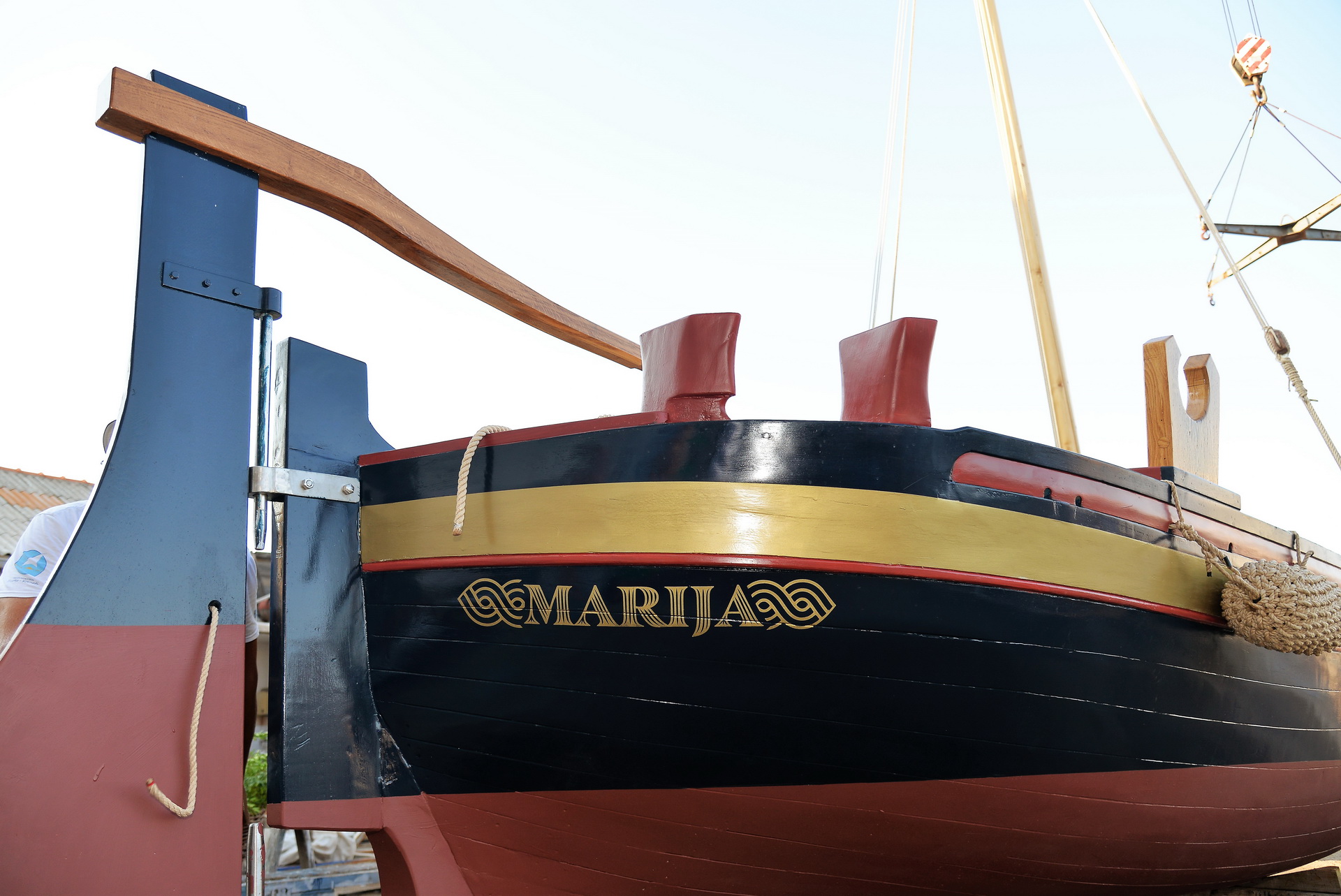
During the restoration process, about 70% of the frames were replaced, along with the stern and bow structural blocks, keelson, keel, most structural elements, gunwales, covering boards, deck, and the complete rig and equipment. Today the boat has been fully restored.
The restoration works were carried out by boatbuilders Nikola and Krešimir Papeša, Ante Jelić, Nikola Balin Nijemac, Siniša Mikin and Ante Sladić, each leaving their personal mark on the vessel.
At present, Marija is powered by four oars and a lateen sail, and next year we plan to install an engine.


The project “Development of Socio-Cultural Infrastructure and an Open-Air Museum of the Betina Museum of Wooden Shipbuilding”, within which the gajeta Marija was restored, was co-financed by the European Union through the European Maritime and Fisheries Fund.